I still remember the first time I held a Tarot de Marseille. I love the mystery of the TdM, and the fact that no one can really pinpoint how it all came together. It was like holding a piece of history. I didn’t know what the cards were trying to tell me at first, but their meaning became clearer the longer I sat with the cards.
I had the same reaction to The Rider-Waite Smith Tarot. The fact that that I held a deck of cards that had existed for almost one hundred years that I could see myself in them was proof that magic existed. Again, I eschewed the guidebook and learned the cards trying to take in what I saw. The cards took me a while to learn, but what a journey it was.
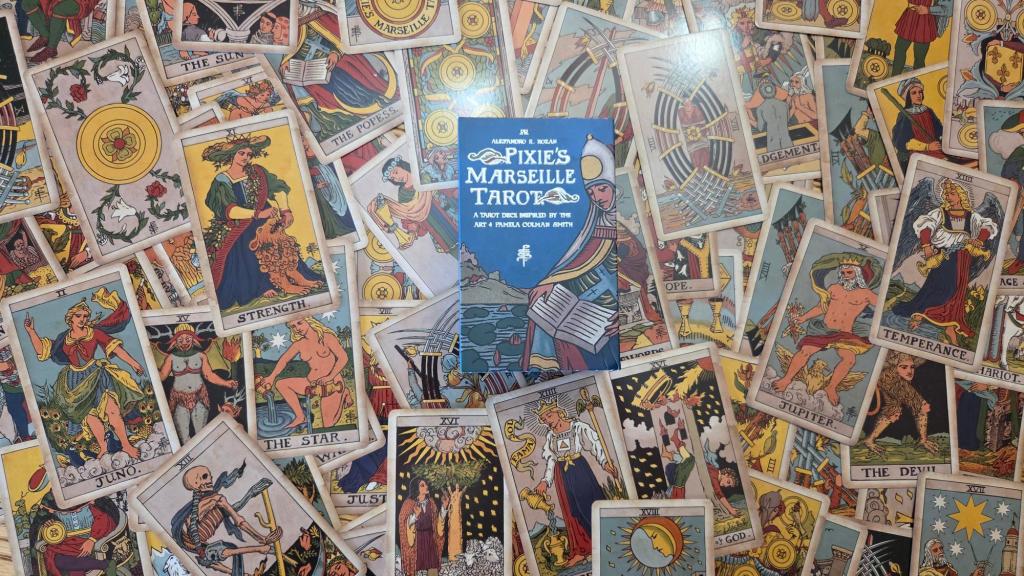
I have many different editions of Ryder Waite Smith Tarot and the Tarot de Marsaille and each of them are steeped in history and meaning. I know the almost unknown history of the cards, but I have never seen anything like Pixie’s Marseille Tarot. It’s magic and history combined and it is astounding.
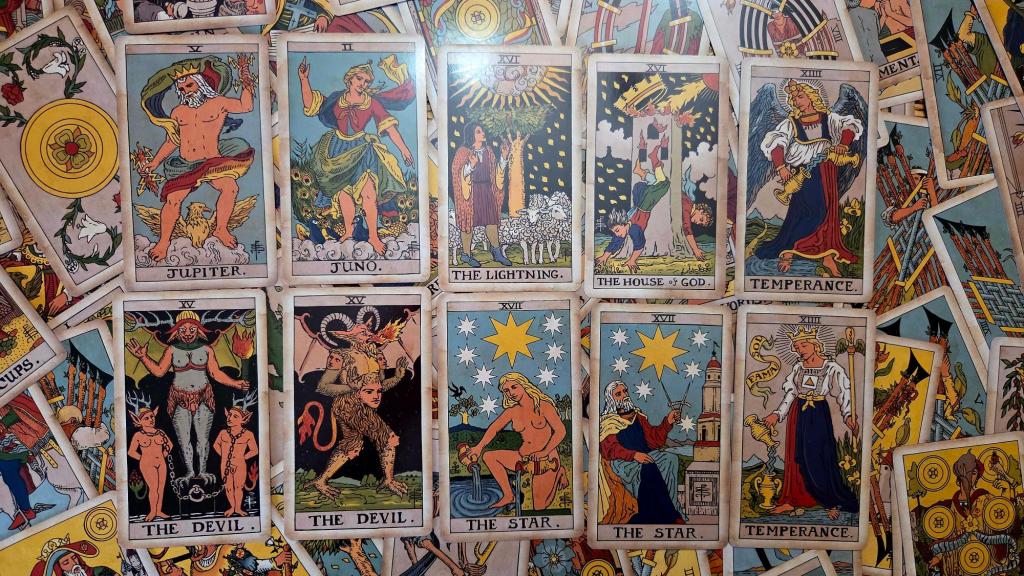
Alejandro R. Roman has created true magic with Pixies Marseille Tarot. He has used the style of Pamela Colman Smith and imagined what a TdM Tarot would look like through the lens of the RWS framework. The result is something that feels like a part of history and yet at the same time, it forges a new path forward.
When I started to read with the cards, it was like I was seeing Tarot in a new light. Having the TdM married to the RWS makes each card not only a window into yourself, but also a mirror that immediately deepens your connection to the cards. Rozan has balanced the two so that they compliment each other seamlessly.
Sometimes, like the 3 of Cups, it’s the barest nod to Pixie and in other cards, her style is alive and well. It’s a hard feat to make a deck that both recalls what we know of Pixies art, but an even more difficult thing to do to create your own style, while remaining true to the source material. There is so much love, both for Pixie and TdM, and it’s evident in each card of this gorgeous deck.
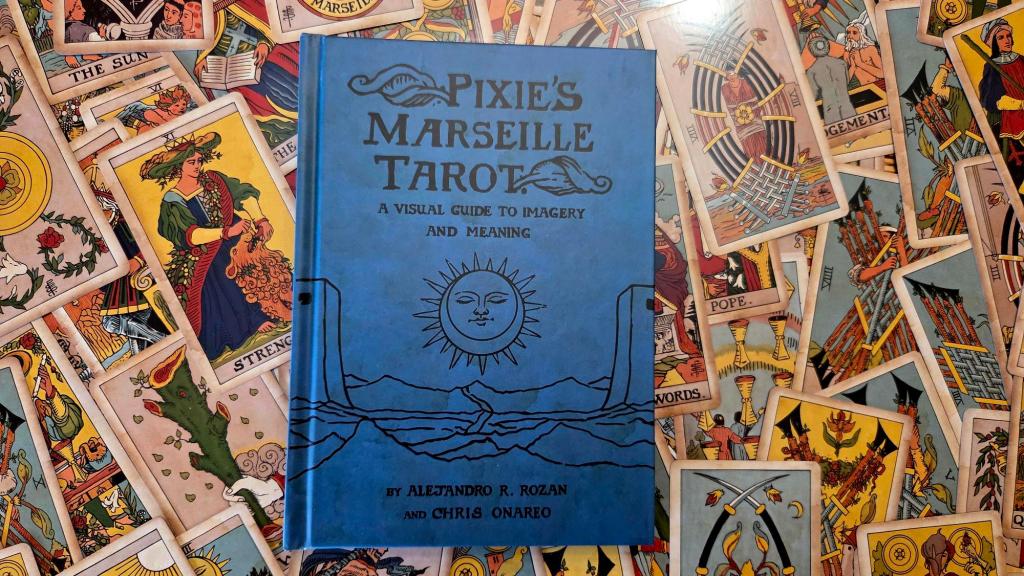
The Visual Guide to Imagery and Meaning by Alejandro R. Rozan and Chris Onareo that accompanies the deck is an incredible journey not only through Tarot but the symbolism and images within Pixies Marseille Tarot as well as Rozan’s process of drawing the cards. We’re also given Rozan’s journey to finding Pixie again and the spark that inspired the deck. The card meanings bring you further into each card. Each is given a page so that you can examine the art more clearly. Part history, part guidebook and part art book, The Visual Guide to Imagery and Meaning goes beyond the little white book. It’s a thing of beauty in and of itself.
This is deck features 85 cards with several having two versions of some cards such as the Moon, Temperance and the Devil for those that would like to choose. Personally, I kept all the cards in the deck. The cardstock is beautiful and done in a semigloss that shuffles smoothly. The cards are housed in a gorgeous magnetic box with silver accents that match the silver gilding on the card edges.
Pixie’s Marseille Tarot is a beautiful gift to the world of Tarot that feels like I am walking through history and I am so thankful for it.
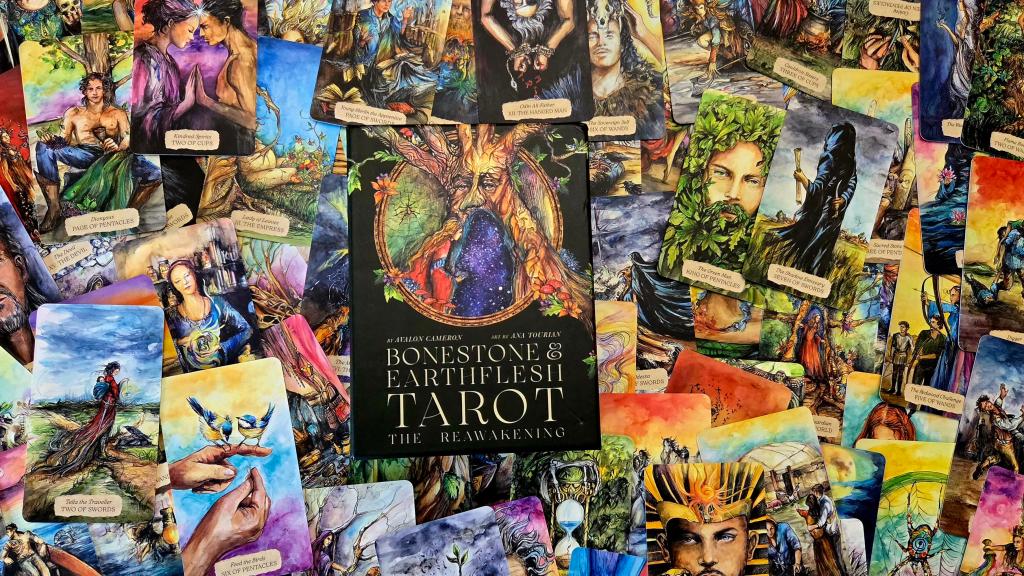
Of course, I knew about The Bonestone and Earthflesh Tarot when it first came out.
It was independently released and a very limited printing and I just remember people being so thrilled to have snagged a copy of the deck. I hadn’t been lucky enough to do so and the deck kind of fell off my radar until I learned that the deck was being re-released and published by Lewellen and Blue Angel. I delved into the online images and discovered a whole new world.
Inspired by the legends and myths of before times, I was curious to see the deck looked. I wondered at a tarot deck filled with beings from all kinds of beings from myth and mysticism. I was a little worried about it. I had used decks that drew from myth and legend before, but they had been centered to one mythology or one type of legend. Would the deck work at all? Sure, the art was gorgeous, but how would the cards read? I was so curious and really wanted to delve into the world that Avalon Cameron and Ana Tourian had created.
When a friend gave me a gift card for Yule, I knew that there was only one thing I wanted. I got myself a copy of The Bonestone and Earthflesh Tarot. I opened the box and was prepared for disappointment, positive that my excitement would not continue after the fever pitch. It’s like this sometimes with decks. I thirst for some decks, only to find that as a whole, the art doesn’t work or the guidebook is badly written. They become part of my collection, but I don’t use them, the attraction I felt for the cards gone now that the thirst was satisfied.
A lot of the decks I thirst after do end up salivating that thirst and continue to do so. Examples of decks like this are The True Black Tarot, The Emphere Tarot, The Spacious Tarot, The Light Seers Tarot, Fifth Spirit Tarot, Tarot La Base!, The Painted Tarot and The Phantomwise Tarot. These are card I turn to again and again for guidance and advice, but there are so many others that don’t. There is nothing worse in the world of cartomancy than waiting for a deck for what seems like forever and finding that I don’t connect with the deck at all once I have it in my hands.
That didn’t happen with The Bonestone and Earthflesh Tarot: The Reawakening. Instead, it has only increased. I’ve pretty much used this deck exclusively since December. Whenever I go to read with he deck, I’m drawn back into the world that has been created within the cards. When I open the box and flip through the cards, the art just pulls me into a world that I want to be part of. Added to that, it’s widened my knowledge of legend and lore. I was surprised by how many of the myths and stories I did recognize, but there were so many other cards that featured legends that I did recognize.
In a way, the Bonestone and Earthflesh Tarot has helped to guide me back to a place within myself that I had closed off. It gave me the windows that I needed to look within myself and helped me to find the door I wanted to open. More than that, the card helped me to see myself as I truly was without all my perceived failings and negativity. It can be a very raw deck or a very healing one, it all depends on the cards I pull. I love decks that aren’t afraid of telling it like it is. I’ve never been afraid of the shadow side of things. I mean, we’re not made completely of light. There would be no light without the shadow, so we can’t ignore the negative. It is what helps us to grow. The Bonestone and Earthflesh Tarot does this with impeccable balance. Using the cards gave me a new light to shine upon myself and I am forever grateful.
The deck comes in a beautiful two-piece box with a lifting ribbon, and the cardstock is absolutely fantastic, thick but nice and springy. It shuffles beautifully, whether you are overhand shuffling or riffle shuffling. The colours of the art are amazing and vibrant, and you can tell that creating this new version of the deck was a joy. The inside of the box holds the message: This is a world between worlds, a place of discovery, redemption, damnation and self-realisation. How will you weave your story? The Bonestone and Earthflesh Tarot helped me to see the kind of story that I wanted to weave in my own life and have helped immeasurably in re-discovering the parts of myself that I had hidden a long time ago. It was a comfort sometimes to delve into the guidebook and learn about the myths and then read the stories to find out how I could relate to each card.
I wasn’t at al prepared to have this kind of connection with a deck of cards. My go to deck is The Wild Uknown. I received it for a gift from another friend years ago and have even gotten a tattoo of three cards from the deck on my right arm. Up until now, The Wild Uknown has been my spirit deck, but it looks like I finally have another.
The guidebook is a dream. Printed in full colour, it’s a chunky guidebook filled with spreads, a bit of tarot history, rituals and the secrets that the cards hold. It’s not only a tour through the cards, but a tour through your own spirit as well. Each card has an entry on what the cards means, the story or narrative behind the card and the upright and reversed meanings as well as numerology and astrology notes for each card and journal prompts that will enhance your writing and help you get to know the cards in more personal way.
When you get to the Minor Arcana, you are given an overview of what each suit means and symbolizes before they get into the cards themselves. I’m normally not one for guidebooks but have found myself diving in and reading the story that the cards present. Even more, as I said above, when I delved into the myths and legends brought to life by each card, I took the time to see how those stories could be a mirror to what I was going through. Tarot and story have always been mirrors for me to help me see myself completely. I turn to Tarot to learn more about myself, but rarely am I shone where I need to look in myself so clearly.
I normally flip through the guidebooks that come with most deck and instead I work to find myself in the cards. However, the companion book to the Bonestone and Earthflesh Tarot: The Reawakening reads like those storybooks I loved so long ago as a kid that helped me look at myself and how I interacted with the world by giving me examples of how things could be. The companion book read like this and it contains so much lore and wonder.
I am in awe over everything to do with this deck. Everything from the gorgeous box to the guidebook and the cards contained within is absolute perfection. I can’t wait to see what The Bonestone and Earthflesh Tarot can help me to learn about myself as I continue my journey onward in the land of legend and mythology.
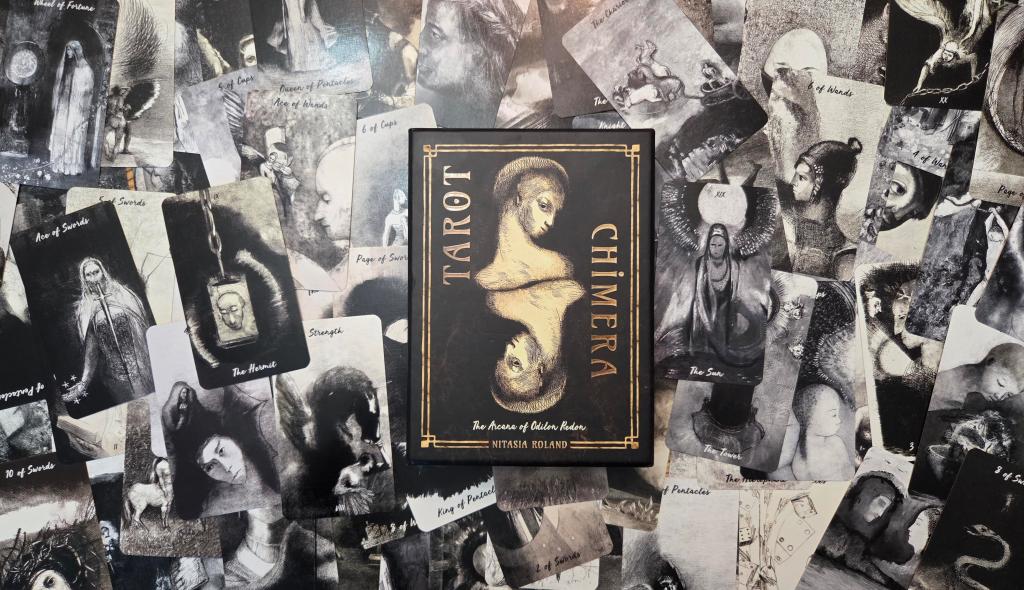
I saw the Tarot Chimera in a video deck review by The Hermit’s Cave (which can be seen here: https://www.youtube.com/watch?v=bNgJl9mCgDY&t=770s ) and was immediately smitten. I loved the designs, the quiet play of light and dark, the drawings that were at once arresting and intriguing. For a lot of the cards, they reflected the emotion or intent, even if it didn’t contain the symbolism of each card.
I’ve always loved tarot decks that delved into the shadows a little to see what could be found. The Shadowland Tarot, The Wanderer Tarot and Carnival at the End of the World Tarot and The Starman Tarot are great examples of decks that ask you to look at the darker elements of life and show you where you can find the light.
Naturally, when I saw the Tarot Chimera, I knew that it was perfect for me.
Created and curated by Nitasia Roland, Tarot Chimera features the breathtaking art of French Symbolist artist Odilon Redon (1840–1916). It is styled in the RWS framework and the artwork by Rendon is surreal and haunting, but so incredible.
Redon was a well-known artist and symbologist who dealt with the speculative, loved symbols and the magic that they contained. Roland writes about her journey with Redon his art in her expertly written guidebook. She thought the art naturally lent itself to a Tarot deck and she is not wrong. The art by Redon is just breathtaking on its own, but when paired with a card number and meaning, it adds depth to the art. The images give new meaning to the cards, and I found myself getting blissful lost within the cards.
Roland has written an incredible guidebook that takes you on a journey of its own. She talks about Redon and what called her to his art and how his art reflects the shadowy dark part of our psyche. Her card meanings are spot on, not just in meaning, but she tied the art to the card beautifully. She took me on a journey within myself. I always look at the cards first and then sit with the guidebook, but she has designed something that works in sympatico with each other. You can read with the cards on their own, but the guidebook helps take you to places you may not have expected or normally associated with the cards.
Weiser has done an incredible job in quality. The cardstock is top notch, and the gold gilding is superb. It’s a linen cardstock that shuffles so beautifully and it’s only got a tiny bit of a glaze to it, and this helps the art pop even more than it would have. It’s a beautiful deck to overhand or riffle shuffle with. This is a sumptuous and surprising deck.
This deck of cards made me feel like I was walking around in the spirit and psyche of its creator and seeing parts of myself reflected back at me. I can’t wait to get lost in the shadows of the Chimera and find out what they have to say to me.
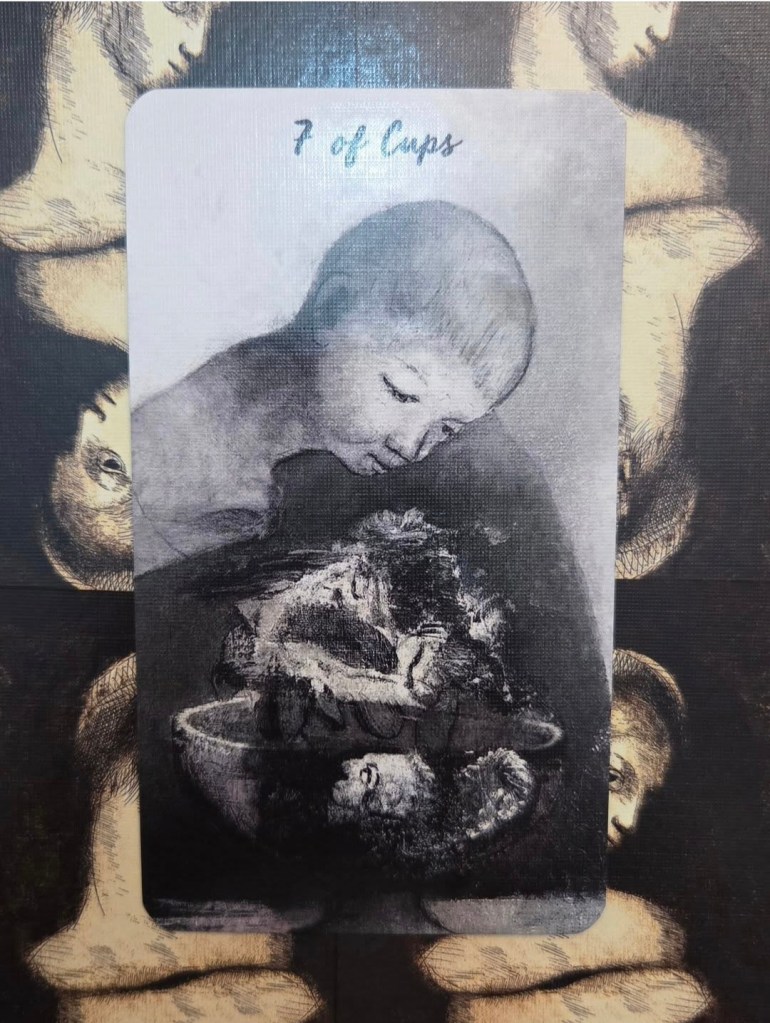
Card of the Month: 7 of Cups
The world around us is full of turmoil, so it’s a good time to look within to give you time to breathe. You are being given an opportunity to look at the parts of yourself that you have kept in the dark. When you close your eyes, it can be difficult to find your way in the dark. Take time to look at the different treasures you can see.
Though there may be some difficult things to take in about yourself, remember that all the parts of you, even those that you’ve kept in the dark, deserve love. When you look within, you may not recognize the parts of yourself that you’ve kept hidden, but they have never stopped believing in you.
Find the inner child and look within yourself with wonder.
I don’t think there will ever be a last tarot deck.
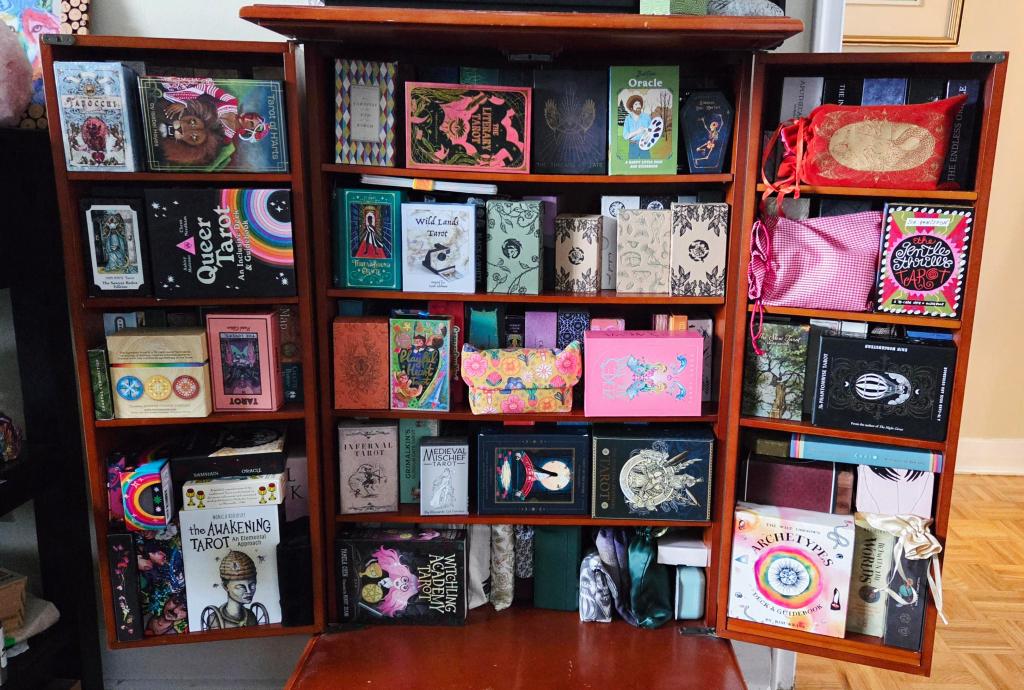
I’ve come to realize that as much as I love reading tarot and delving into the different facets of myself, I love collecting new tarot decks and other tarot related creations that call to me. With each one I find, be it a deck of Tarot, Oracle, Kiper or Lenormand cards, it’s like I’m finding a part of myself.
Tarot has become a part of how I breathe and that breath changes focus over time. There are times when I feel like I need strong guidance and wise counsel and other times when I need a soft and gentle hand to guide my way. I always find myself going to different decks for different situations. I’ve tried to stick with only one deck, and I did for a while. My first deck was The Ancient Egyptian Tarot by Clive Barrett. I love the mysticism that Egypt holds and using those cards was like communicating with a deeper part of my spirit. The Ancient Egyptian Tarot was with me during one of the most difficult times in my life and is part of me.
After a break from card slinging, I learned to read tarot again with the Thoth Tarot and after I spent a lot of time with those cards, I needed to find a different path for myself. My path with the Thoth Tarot ended badly, though this had nothing to do with the cards themselves, but the person who taught me to read with them. I wanted to find comfort after a difficult time and knew that I had to walk away from the Toth Tarot. It was too wrapped up in who he was. I backed away from Tarot because of my experiences with the deck and my teacher. I still felt that I needed some kind of guidance and found myself turning to Oracle cards.
I found myself drawn to The Enchanted Map Oracle by Colette Baron-Reid. They were a revelation at the time and provided me with soft comfort and much needed advice that I needed to turn my mind around and to not just focus on the positive but find a way to let go of the negativity so that I could see the path in front of me clearly. I had no idea that my path would lead me to meet Colette with my friend Christine. I consider myself lucky that I got to meet Colette, but the shine that I felt followed her dulled after meeting her and so did my love for her cards.
There were other Oracle cards that were able to guide me through what I was going through, but I was itching to find another Tarot deck. I love Oracle cards, but Tarot would always be my first home.
When a friend gave me The Wild Unknown for Christmas, it was like I had found a piece of myself that I had given away a long time ago. I was hesitant picking up another tarot deck after what had happened with the Thoth Tarot. However, after a time with so much darkness, it was like finding light in the shadows, and Kim Krans uses colour to great effect within the art of The Wild Uknown, using the shadow to show how powerful a spot of light or colour can be.
It is the deck that I always return to, no matter how many decks I own. It’s where I feel most at home. The Wild Unknown is the deck that somehow gives me breath in a world where I sometimes don’t feel like I can breathe. I have three cards tattooed on my right shoulder so that I can carry them around with me: the Ace of Wands, Strength and the Ace of Swords. Every day, they remind me what I can create, how I can overcome and what I need to cut away.
Even so, as much as The Wild Unknown holds a part of my spirit, it likes to wander and find itself in new places. I’m always drawn to find a part of myself in something new and if it has gilding on the edges, I’m gone. I have always been a sucker for shiny things. After experiencing The Wild Unknown, I was drawn into the world of Prisma Visions. The Wild Unknown Tarot helped me through a period of growth where I became completely myself and opened me up to what was possible. The world of Prima Visions Tarot was an explosion of colour that lit up the dark and showed me what my world could look like, and it was a world that I wanted to explore. I felt like with each card that I was being drawn into a world where there was finally balance between the light and the dark. I found those cards when I needed to let myself shine because I didn’t want to hide who I was anymore. Those cards showed me that it was okay.
I could go on, but we would be here for a while. When people ask me how many decks I have, I truthfully don’t know the answer. I would wager somewhere between one-hundred or two. There have been decks that have been sold to others or given away to one of my friends who were in need of a little bit of wisdom, but other than that, they have stayed.
I’ve always thought of Tarot cards like doors, they invite into a world of the artists creation. The person who has created the deck is alive within each card, each pigment, each sword, pentacle, cup or wand. The decks that call to me are often at random or ones I’ve been told about, or I spot them on my journeys in stores (both mortar and online). If I know that the store sells Tarot decks, that’s the first thing I go to look at. I almost always find something to take home.
It’s not about just buying a new deck. There must be some kind of spark or story, waiting to be unravelled and lived in. I’m a firm believer that Tarot decks are spirit keepers. I write and paint. I know that a little bit of the magic that I create lives inside each of my paintings. My books always hold characters that are parts or pieces of me, every writer does this. Our lives and imagination inspire the rest.
I think that tarot decks are like that, too. The decks always hold the spirit of their creator. They’ve had that vision, that idea, that story that had to be told with tarot cards. They are world creators, giving their idea a canvas to live out their tale, to hold the energy that they want to imbibe the deck with. Every time I open a new tarot deck that called to me, I am opening a door within myself that has either remained closed, or I didn’t know was there in the first place. I usually sit with a tarot deck, flipping through the cards and letting what I see tell me a story. Then I sit and read the guidebook, so that I can see further into the forest. The guidebook gives me the bones of the deck. It is, after all, the deck creators’ story and vision. They take the forest of cards and help to bring them to life.
My tarot collection of tarot decks has become something more. It’s like each deck is a page in the book that tells my journey, mirroring a different part of my path. It’s a large book that I have compiled, much like a tarot deck that is really a book filled with mirrors. I’ve always used tarot for personal reflection and growth, and each card is a reflection of who I am, that’s how I’ve always seen them at any rate. These decks that have been created with care by so many different deck creators and artists. They may have created a forest to lose myself in, but it’s my intuition that gives me the light to shine through.
Either way, I’ve come to realize that there will always be a new deck that catches my eye and tugs at my spirit. I know this and I’ve come to a good place with it. I know that with each year that passes, there will be many more pages to add to the book of my life.
I recently donated upwards of sixty decks to a charitable foundation. This frees up space a little and it was good to go through the decks that I have and I was able to say goodbye to them and thank them for helping me find different facets of myself. I know that even though I just got rid of a lot of decks, that there will never be a last deck. There is always something that I can learn about myself and the road that I am on in this life.
I can’t wait to see where the cards will take me next.
I’m convinced that Jennifer Cooper Steidley is a Symbol Goddess.
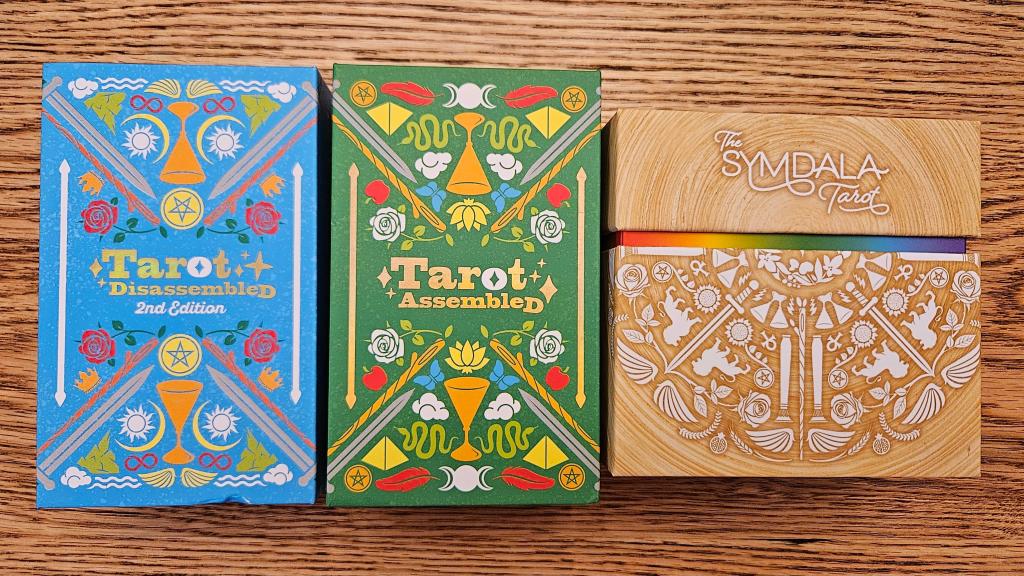
I’ve been a longtime fan of her independently released works including Tarot Disassembled, Tarot Assembled and The Symdala Tarot. They are wonders of symbolic imagery held within the tarot and given a new light and life. They take the Rider Waite Smith Tarot, perhaps the most famous tarot deck, and break every card down into the symbols that each card holds.
The decks are full of symbols, and you’d think that would difficult to read with, but it shows us the pieces and players each Tarot card holds and the energy within. What’s more, her cards let us move them around to tell our own story. Tarot Disassembled helps us take a look at the tarot cards we know so well by breaking each card down to the symbols they contain.
Tarot Assembled breaks down the symbols even more by giving us a gorgeous pallet of colour. I can’t be the only one who responds in a different way for different colours. I feel morose or thoughtful when I see grey, joyous when I see yellow, thoughtful when I see green. Steidley has each let us gaze not upon a card full of symbols, but one single symbol that the Tarot contains. Tarot Assembled has us take a look at the tree that makes up the Tarot and in contemplating the single symbol, we can put the Tarot we know back together.
The Symdala Tarot takes the symbolic journey of the Tarot even further and creates a mandala out of each card. These mandalas give you space to pause, reflect and see even deeper into what the cards mean. What’s more, the words around the edge of each card and the symbols within these circular cards create windows and portals into different parts of ourselves. The cards ask that we meditate upon the images and words that the card holds and I love that about them.
I love the guidebooks that come with each of the decks. They are compendiums of the symbols to be found within and what these symbols mean. They are a wealth of information and knowledge and each time I open one and delve in, I find myself happily lost in a world of words and symbols. I love how Steidley has given me a new way to look within the cards that I know so well and see something new even though I’ve been using the RWS Tarot for years now.
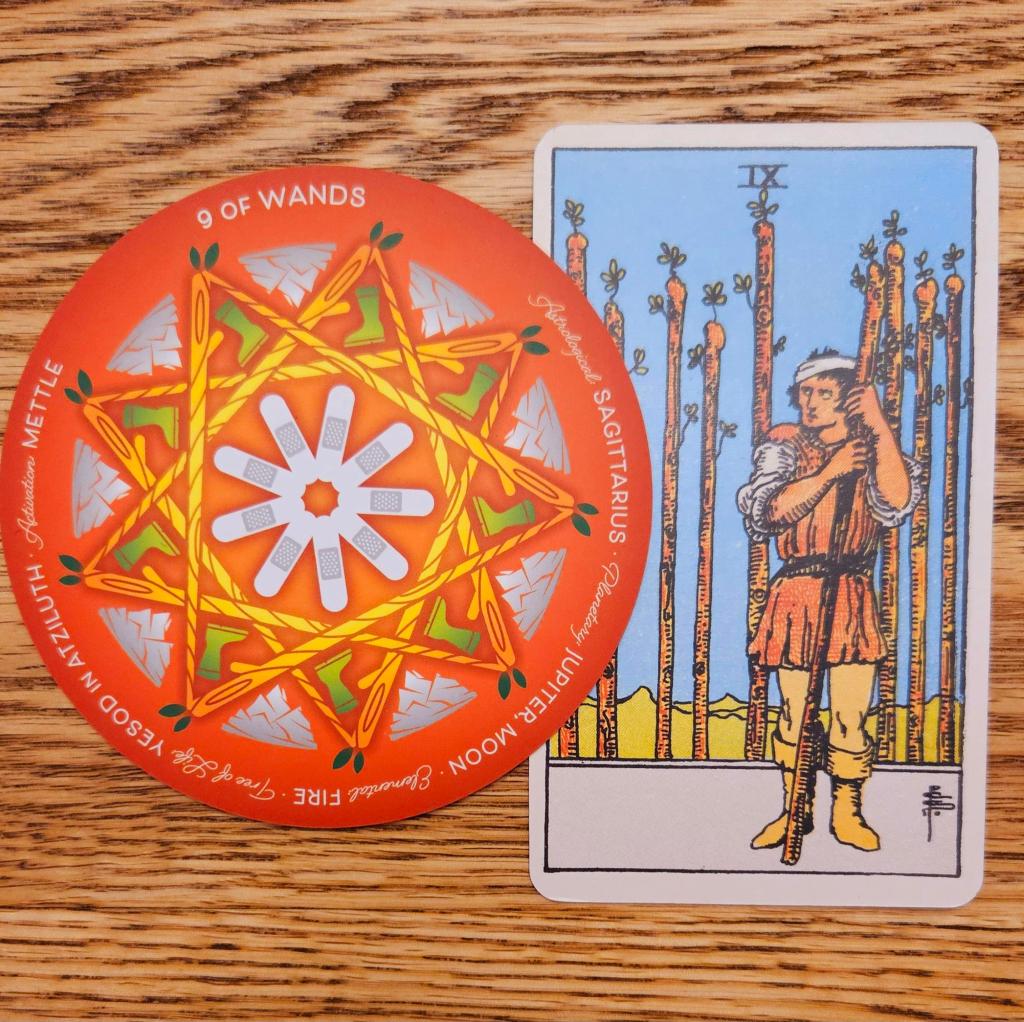
Case in point: I was drawing a card for myself from the Symdala Tarot the other night. I have been going through some health issues and wasn’t surprised to draw the 9 of Wands. What intrigued me was the bandage at the centre of the symbolic mandala. I had never seen a band-aid in the 9 of Wands. I went to my RWS and found the corresponding 9 of Wands card and right there on the man’s head was a bandage. I stopped and looked at the card from the Symdala Tarot and the RWS side by side and I really appreciated how Steidley took a card I knew so well and helped me to see something new within it. It’s like this every time when I’m using her cards.
I was beyond thrilled to hear that Tarot Dissembled was being published by Weiser. I love this deck so much because it started me on my journey of looking deeper within the cards. When I first started using the independently published Tarot Disassembled, I would draw a card and find myself being drawn to a particular symbol. Even through the symbols were all separated, if I followed them, they told a story. When I would read with other decks that were based off the RWS Tarot, I would see symbols that Steidley had brought out into the light. I’m can see the symbols so much more clearly.
More than that, she helped me to fall in love with the Tarot again because she made its language simpler to understand. After so many years of reading Tarot cards, things can start to seem a little boring. I sometimes lose my enthusiasm about Tarot, like everything else in life. Sometimes you need a break. I love all of my decks (and there are a lot of them) but there’s just something about going back to Tarot Dissambled that gives me a reset and much needed reboot. Having the symbols laid out for me reveals the language that Tarot uses to communicate. The decks by Jennifer Cooper Steidley are all like this, but Tarot Disassembled has a special place in my heart because it’s where I first saw the skeleton of each card through the images that she created.
Tarot Disassembled brought so much light into my life and not just because of the symbols that were finally given the limelight they deserved. The whole deck is a fabulous riot colour and it was my hope that when the Wieser version of Tarot Disassembled was published that it would honour the spirit of the deck I knew so well.
Thankfully, the Red Wheel/Weiser Books edition of Tarot Disassembled is just as amazing as the independently published version of the deck. The cardstock is lovely, the matte finish whispery and the yellow edges are amazing. My favourite colour is purple, so I was thrilled beyond words to find out that it had been added to the colour pallet of the cards. It was a joy to go through a deck that I knew so well to see if I could spot the differences in the cards.
I think what I love most is the fact that the Red Wheel/Weiser Books edition of Tarot Disassembled preserved the heart and spirit that makes the deck so special. The guidebook is still the wonderful grimoire of symbols, legend and lore and the cards are spectacular. I’ve got my first and second edition of the Tarot Disassembled, and they are thrilled to welcome their new sibling.
The Tarot Disassembled deck and guidebook by Jennifer Cooper Steidley and published by Red Wheel/Weiser Books is absolute magic.